On the Way — reading Mark
Reading tools
Four structural moves that let Mark's Gospel argue with itself
Mark composes in shapes. He does not tell a story in a straight line; he sets one scene beside another, brackets a section with a matched pair, silences the wrong witnesses and lets the right one speak at the wrong moment. The four reading tools below are compositional moves Mark uses across the whole Gospel. Once seen, they cannot be unseen; the reader who learns to read for them starts finding the argument Mark is making with the shape of his book.
Each tool has a primary home in one of the sixteen sessions of On the Way, where the passage under discussion is the exemplary case. The infographics gather the pattern across the whole Gospel so the reader has the full picture in view.
Framing pericopes
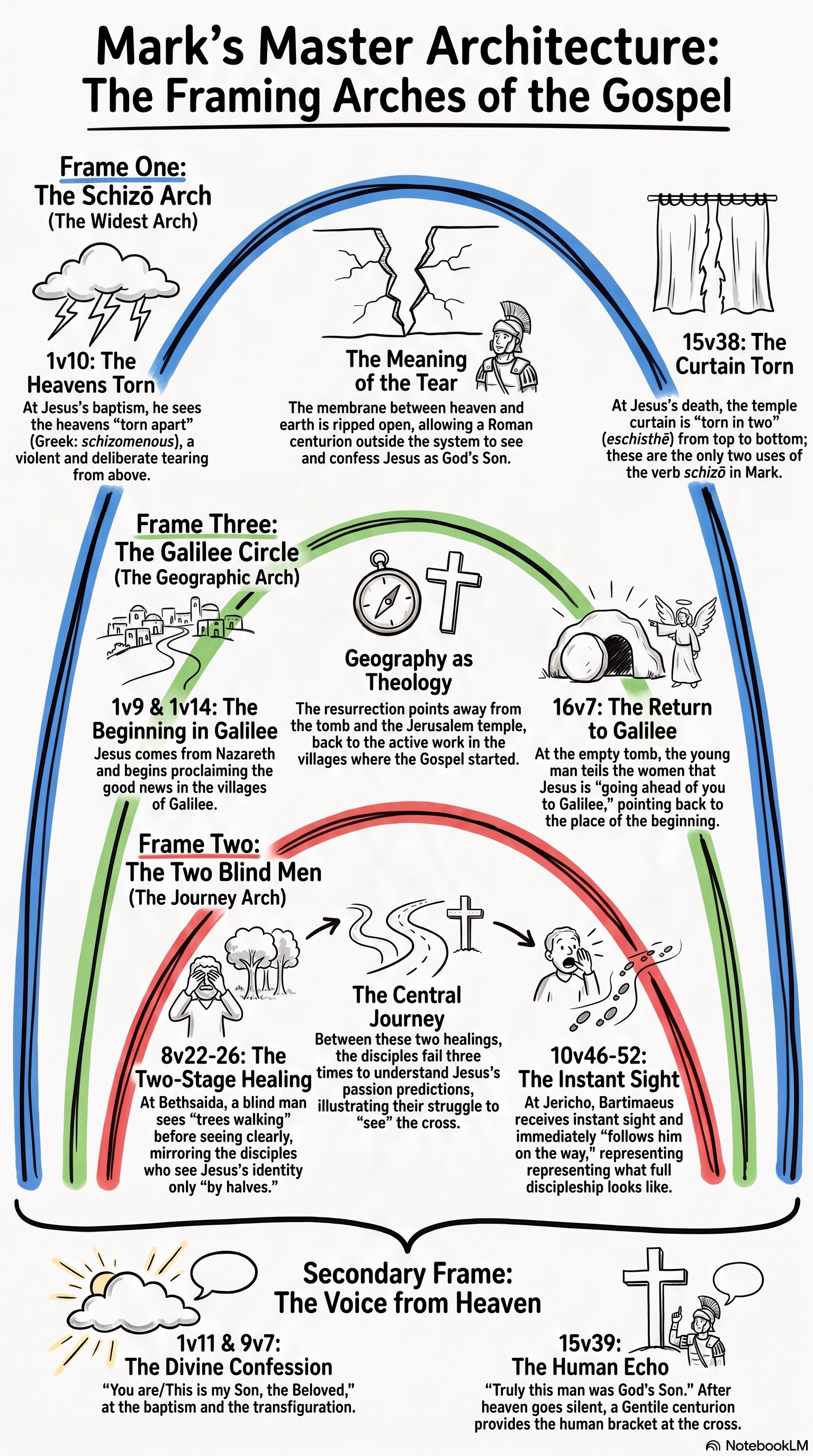
Mark places two similar scenes a long way apart to bracket a section of his book. The scenes are not doubled by accident; they interpret each other across the gap, and the material inside the bracket is doing what the bracket names. Three wide arches run across the Gospel: the schizō arch (heavens torn at the baptism in 1v10; temple curtain torn at the cross in 15v38); the two-blind-men arch (Bethsaida in 8v22–26; Jericho in 10v46–52); the Galilee arch (the work begins in Galilee in 1v14; the risen Jesus goes ahead to Galilee in 16v7). Inside each frame sits a stretch of the Gospel doing the work the frame announces.
The two blind men are the textbook case. The first healing is two-stage and slow; the second is one-stage and immediate; between them sit three passion predictions and three disciple failures. The disciples are the man at Bethsaida seeing people like trees walking; Bartimaeus is what full sight looks like — he throws off his cloak, asks for sight, receives it, and follows on the way. Session 12 (Bartimaeus) is the primary home for this reading tool.
The Markan sandwich
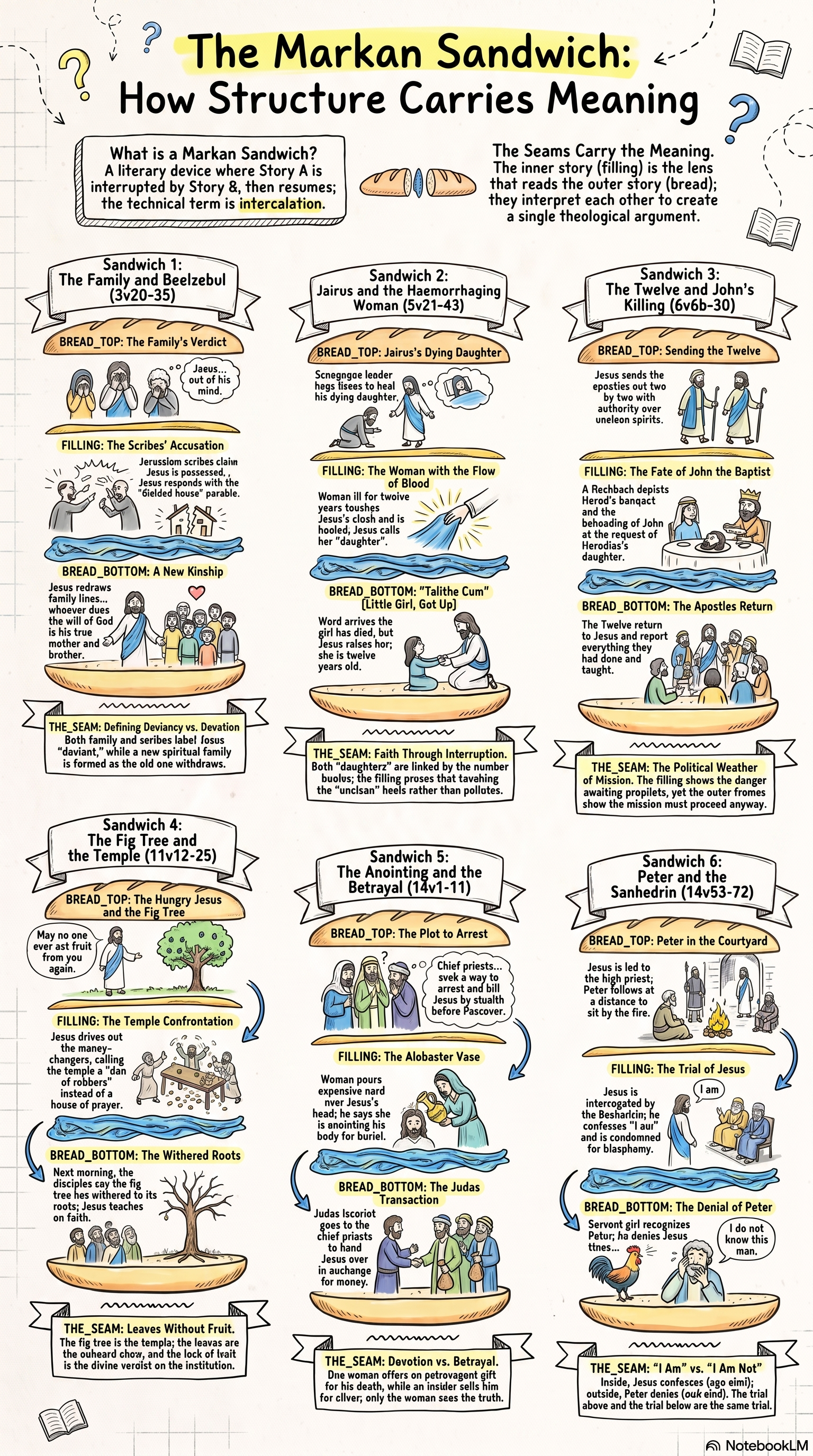
Mark begins a story, breaks off to tell another, then returns to finish the first. The inner story reads the outer and the outer reads the inner; the meaning sits in the seam. Six sandwiches are agreed in the literature — the family and Beelzebul (3v20–35); Jairus and the haemorrhaging woman (5v21–43); the sending of the Twelve wrapped around John's killing (6v6b–30); the fig tree around the temple cleansing (11v12–25); the anointing at Bethany between the plot and Judas (14v1–11); Peter's denial around the Sanhedrin trial (14v53–72).
The Jairus and haemorrhaging-woman sandwich is the textbook case. A named synagogue leader begs for his dying daughter; on the way Jesus is interrupted by an unnamed woman ill twelve years; she is healed and called daughter; only then does Jesus go on to the child, who has by now died, and raises her — she is twelve years old. Twelve years bleeding, twelve years alive; the poor woman's healing is the condition of the rich man's daughter's raising. Mark is doing class analysis with numbers. Session 6 (Across the boundary) is the primary home.
The messianic secret
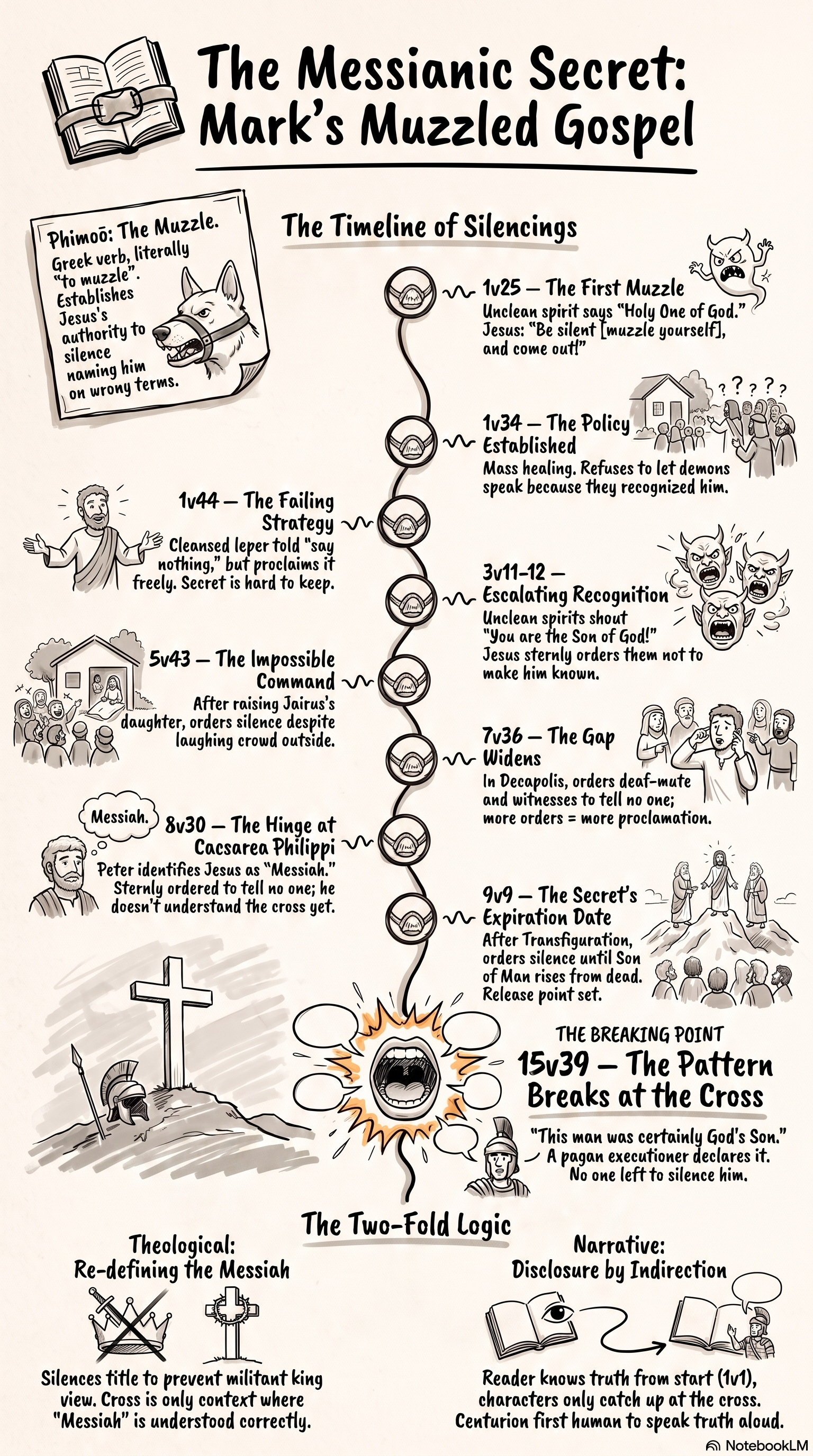
Across the Gospel, Jesus silences those who recognise him — demons, healed people, disciples. The pattern begins at 1v25, when the unclean spirit in the Capernaum synagogue shouts you are the Holy One of God and Jesus tells it to be muzzled. It continues through the healed leper (1v44), the demons at the lakeside (3v11–12), Jairus's daughter raised (5v43), the deaf-mute in the Decapolis (7v36), Peter at Caesarea Philippi (8v30), and the three disciples after the transfiguration (9v9). The pattern breaks once, at the cross, when the Roman centurion says aloud what no one has yet been allowed to say: truly this man was God's Son (15v39).
The silencing at 8v30 is the pivot of the pattern. Peter has the right word (Messiah) with the wrong content; the disciples are silenced because they have not yet seen the cross. At 9v9 the silencing for the first time has a horizon; the secret has an end date, and the end date is the resurrection. Session 9 (Do you still not understand / Who do you say I am) is the primary home.
Parallel cycles
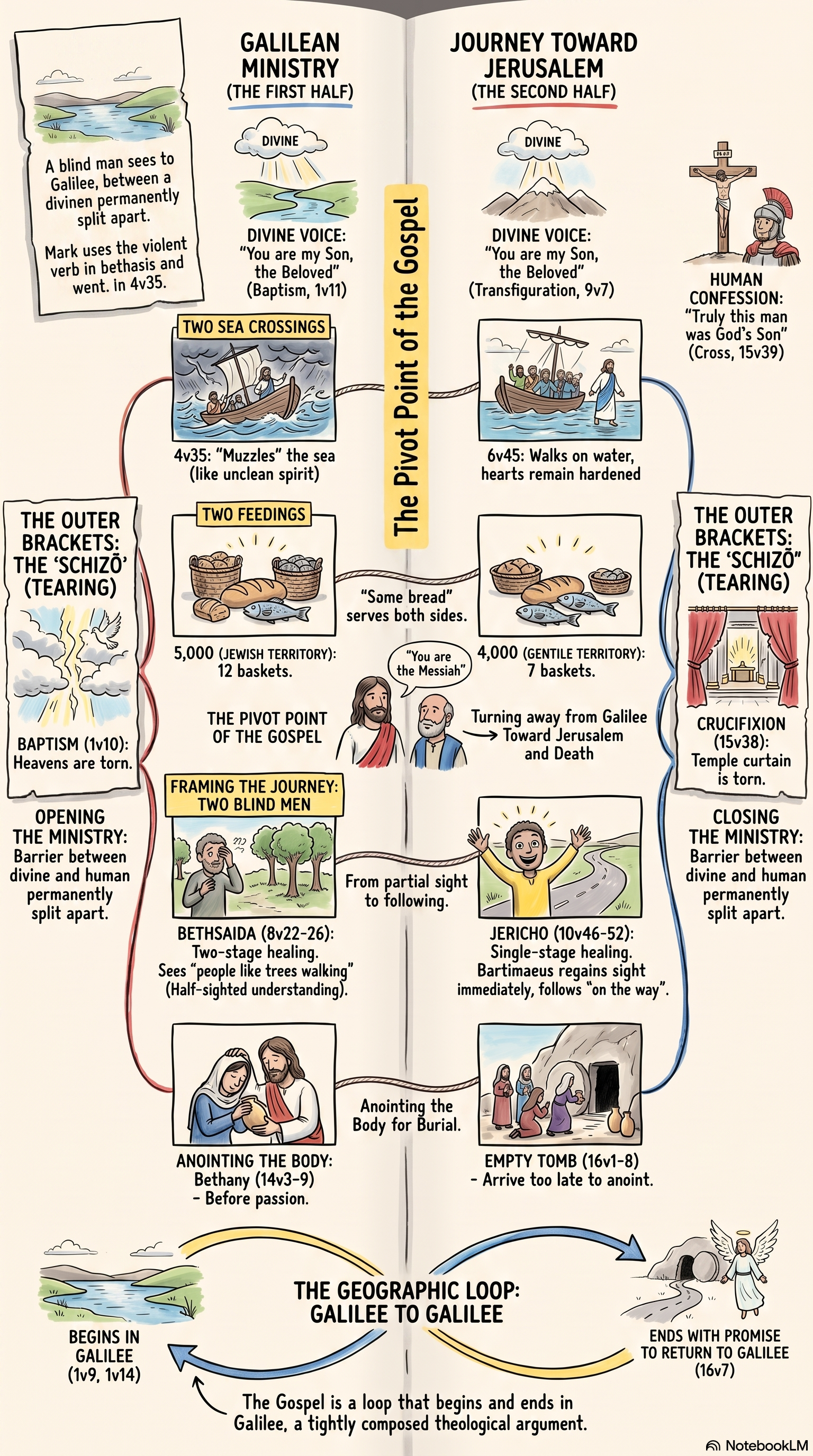
Mark composes the whole Gospel in paired panels. The first half (1v1–8v26) and the second half (8v27–16v8) speak to each other across the Caesarea Philippi spine. Two blind men frame the central journey; two sea crossings; two feedings (five thousand Jewish in Galilee; four thousand Gentile in the Decapolis); two tearings by schizō (heaven at the baptism; temple curtain at the cross); two voices from heaven and a human echo from the centurion; two anointings on either side of the passion; a Galilee-Jerusalem-Galilee loop. Nothing in Mark is incidental. The pairs argue with each other across the spine.
The point-of-arrival for the pattern in the course is Mark 8v21 — and you still don't understand? — the closing question of Part One. Two feedings, two sea crossings, and a chapter of controversy have not persuaded the disciples that the same bread is being served to Jew and Gentile alike; Mark closes the unit with the question because he has more to show. Session 8 (Clean, Unclean / Do you still not understand) is the primary home.
Reading Mark as architecture
The four moves are not decoration; they are how Mark thinks. He composes in frames, sandwiches, silencings and paired panels because the theology asks for paired hearing. The reader who reads Mark linearly, episode by episode, will get half of Mark; the reader who reads Mark architecturally, listening for the echo across the spine and the front bracket and the back bracket, will get the rest. Mark is a Gospel written to be re-read; each of these tools is a reason it rewards the second and third reading.