On the Way · Session 8
Clean? Unclean? Do you still not understand?
Mark 7v1–8v21
Six scenes building to the gospel's structural hinge. Hand-washing, the Syrophoenician woman, the deaf-mute, a second feeding, a demand for a sign, a discussion on leaven — and at the end, the question Mark wants every reader to feel: and you still don't understand?
Pre-session video
This is the last session of Part One of the course. Mark 7v1–8v21 carries the climax of the bread-motif and the climax of the disciples' incomprehension. The chapter opens with a controversy about hand-washing and what defiles a person; widens out into a boundary-crossing encounter at Tyre with the Syrophoenician woman; comes back through the Decapolis with the healing of the deaf-mute man and his Ephphatha; and then turns inland for a second feeding, a demand for a sign, and a discussion on leaven in a boat. Mark closes the unit at 8v21 with Jesus' question to the disciples after the leaven exchange: and you still don't understand?
Three things to watch for
The first is the move from outside-to-inside in 7v1–23. The Pharisees ask why Jesus' disciples eat with unwashed hands. Jesus answers with Isaiah 29 (this people honours me with their lips, but their hearts are far from me) and then redefines defilement: there is nothing outside a person that by going in can defile, but the things that come out are what defile. The Markan parenthesis at 7v19 — thus he declared all foods clean — is the gospel's clearest move against the purity code. The boundary that has organised first-century Jewish life is being relocated from outside the body to inside the heart.
The second is the Syrophoenician woman (7v24–30). The only person in Mark who wins an argument with Jesus. She comes to him for her daughter; he refuses, calling her people dogs; she replies with the line about crumbs and dogs under the table; he relents. The pericope sits at a hinge — Jesus is in Gentile territory; a Gentile woman draws him out of the boundaries he had been working inside. Mark gives her the dialogue and Mark gives her the win.
The third is the bread-motif climax (8v14–21). The disciples have forgotten to bring bread; they have one loaf in the boat. Jesus warns them about the leaven of the Pharisees and the leaven of Herod. They worry about not having enough bread. He reminds them: twelve baskets after the five thousand; seven after the four thousand. The chapter does not let them off. Do you still not perceive or understand? Are your hearts hardened? And at the end, the line that Mark has been building toward for two chapters: and you still don't understand? The question is for the disciples and for the reader. Session 9 will answer it with two touches at Bethsaida.
Reading tool: parallel cycles
What Mark has done inside this session's own material — a Jewish feeding-cycle followed by a Gentile feeding-cycle, with different basket-words and different numbers, closed by the question and you still don't understand? at 8v21 — turns out to be a small instance of something he has done across the whole gospel. Five loaves and twelve baskets on the Jewish side in Session 7; seven loaves and seven baskets on the Gentile side here; then in the boat with one loaf the disciples cannot yet read the doublet as a doublet. The question at 8v21 lands because the first half of Mark has been composed as two matching cycles, and the disciples have served both without seeing.
Zoom out and the move repeats. Two blind men frame the central journey-section — Bethsaida in Session 9, Bartimaeus in Session 12. Two tearings, using the same violent Greek verb schizō, bracket the whole work — heaven torn at the baptism and the temple curtain torn at the cross. Two voices from heaven are echoed by the Roman centurion at the foot of the cross. The work opens in Galilee and closes back in Galilee. Session 8 is where this reading tool is named and shown in the course; once you can see the move here, you find it running everywhere in Mark.
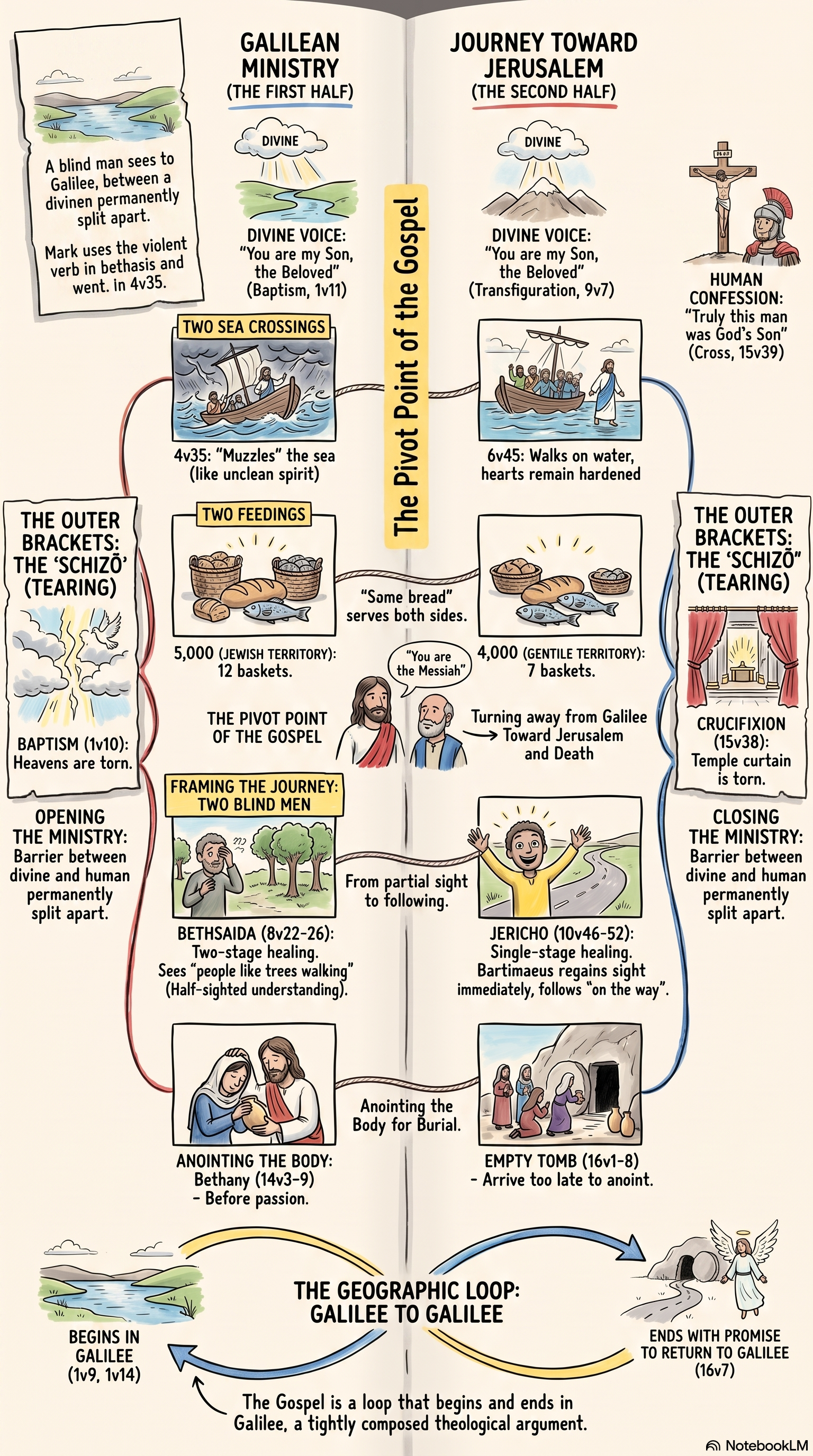
See the full set of structural reading tools at /reading-tools/.
Exegetical key video
Practice for the week
Three to choose from, or write your own. Pay attention this week to where you have inherited a purity code — a sense that something or someone outside you is contaminating — and ask whether the verse nothing outside a person by going in can defile reframes it. Or: find one place where someone outside your usual circle is making an argument that catches you, the way the Syrophoenician woman caught Jesus; consider what changing your mind might cost. Or: name one thing you have been doing without yet understanding it — kingdom work where the heart is hard and the eyes do not see — and ask, gently, for the next stage of sight.
Materials for this session
Facilitator brief, participant workbook, and slide deck are available to registered leaders. Contact adrianroux@outlook.com for access.