On the Way · Session 6
Across the boundary
Mark 4v35–5v43
Four miracles in a row, between two boat crossings. Mark's argument is that Jesus' kingdom crosses every boundary his world drew.
Pre-session video
Mark sets the whole passage between two crossings. Let us go across to the other side, Jesus says at the start; four miracles later, he crosses back. Inside that frame: a storm-stilling in which the disciples ask the question that will drive the rest of the gospel — who then is this? An exorcism on Gentile soil in which a man named only as Legion, for we are many is restored, and two thousand pigs go over the cliff. And, on the home shore again, a woman who has been bleeding for twelve years sandwiched inside the story of a synagogue official's twelve-year-old daughter; two daughters both at the edge of life, both restored.
Name the boundaries. Ethnic — the Decapolis is Gentile country. Demonic — the man called Legion, with the military pun on the Roman Tenth Legion. Ritual purity — the unclean tombs, the unclean pigs, the unclean haemorrhage, the unclean corpse. Gender — a woman, a synagogue official's daughter, both called daughter. Class — Jairus is named and powerful; the haemorrhaging woman is unnamed and poor. Age — a twelve-year-old girl. And, at the end, the boundary every one of us hits eventually: death itself. Talitha cum — little girl, get up.
Three things to watch for
The first is the question at the end of the storm. Who then is this, that even the wind and the sea obey him? This is the question Mark will keep asking for the next ten chapters. The disciples have just watched Jesus do what only God does in the Hebrew Bible — still the chaos of the deep — and they ask it as if they had not seen what they had seen. The slowness of disciple-understanding is being seeded here.
The second is the Markan sandwich at 5v21–43. Jairus begs; on the way the woman touches; the woman is healed and called daughter; only then does Jesus go on to the named official's daughter, who has by now died. Talitha cum — she gets up. Twelve years bleeding for the woman, twelve years alive for the girl. Mark is doing class analysis with numbers; the wealthy and the poor; the named and the unnamed; the man's request and the woman's interruption. The eleven-word sermon at the centre of the passage — the rich will not find life until the poor stop bleeding — is the line the room carries home.
The third is the holiness that runs the wrong way. Under the purity code, touching tombs, pigs, a haemorrhaging woman, or a corpse all make you unclean. In this passage Jesus touches all four. None of them make him unclean. The contagion runs the other way. Holiness is the infectious thing, not impurity.
Reading tool: the Markan sandwich
Watch the move before we give it a name. Jairus falls at Jesus' feet begging for his little daughter; on the way, a woman who has bled for twelve years reaches through the crowd and touches his cloak; Jesus stops the procession, finds her, calls her daughter. Only then does he go on to the twelve-year-old girl, who has by now died, and speaks two Aramaic words — talitha cum, little girl, get up — over her. Twelve years bleeding for the woman; twelve years alive for the girl. The two stories are one story; the interruption is where the meaning sits.
Mark does this six times across the Gospel. The technical name is intercalation; the plainer name is the Markan sandwich. The infographic below sets out all six side by side. Session 6 is where the course teaches the tool by name; the pericope in front of us is the textbook case.
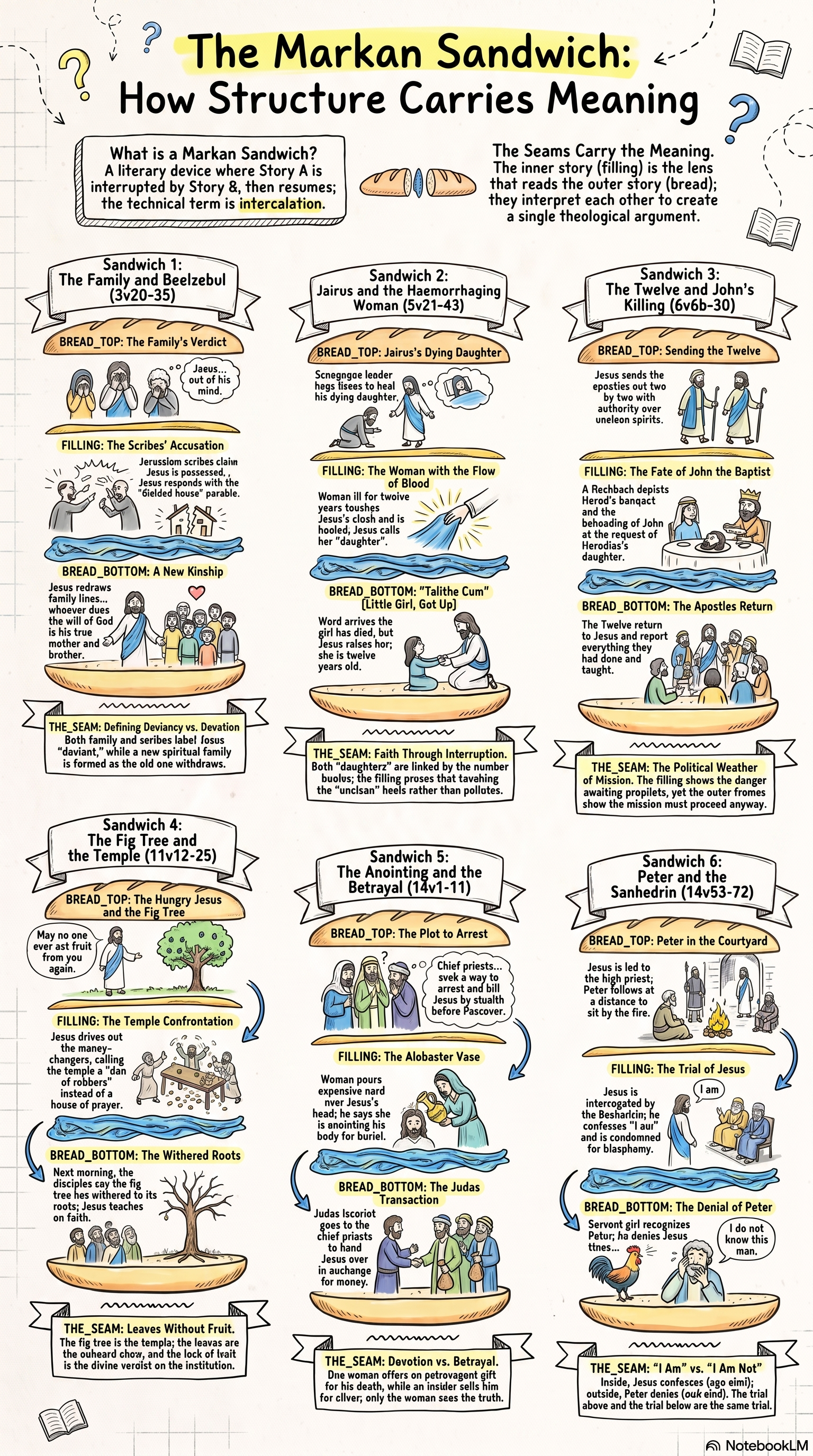
For all four structural reading tools, see the Reading Tools page.
Exegetical key video
Practice for the week
Three to choose from, or write your own. Notice one boundary in your own life — ethnic, social, religious, generational — and consider what it would cost you to cross it. Or: find one person this week who is bleeding and unnoticed in the room and stop for them, the way Jesus stopped for the haemorrhaging woman. Or: identify one place where you are wailing where Jesus would say not dead but sleeping; sit with the difference.
Materials for this session
Facilitator brief, participant workbook, and slide deck are available to registered leaders. Contact adrianroux@outlook.com for access.