On the Way · Session 9
Do you still not understand? Who do you say I am?
Mark 8v22–9v13
The pivot. Bethsaida opens the journey-section with a man who needs two touches to see. Caesarea Philippi sets the question that defines everything. The first passion prediction. Peter's rebuke. Take up your cross. The Transfiguration. The Elijah descent.
Pre-session video
This is the first session of Part Two of the course. Mark 8v22 begins what scholars call the journey-section — the long stretch from Bethsaida in the north to Bartimaeus at Jericho, framed by two healings of blind men. Bethsaida opens the journey; Bartimaeus closes it. Between them, Mark builds his catechism of cross-shaped discipleship.
The session falls in two arcs. The pre-Transfiguration arc (8v22–38) carries the Bethsaida healing, Caesarea Philippi and Peter's confession, the first passion prediction, Peter's rebuke and the Get behind me, Satan, and the call to take up the cross. The Transfiguration-and-descent arc (9v1–13) carries the saying about some standing here who will not taste death, the Transfiguration on the high mountain, and the conversation on the way down about Elijah and the suffering Son of Man.
Three things to watch for
The first is the two touches at Bethsaida (8v22–26). Jesus puts saliva on the blind man's eyes and asks: can you see anything? The man looks up and says: I can see people, but they look like trees, walking. Jesus lays his hands on his eyes again. The man looks intently and his sight is restored. He sees everything clearly. Mark places this pericope as the gospel's structural image: the disciples (and the reader) need two touches to see properly. Partial sight at Caesarea Philippi — Peter sees that Jesus is the Christ but not yet that the Christ goes to the cross. Full sight will come eventually. The pattern is hopeful — partial sight is real sight, and Mark expects the second touch to come.
The second is Peter's confession and rebuke (8v27–33). Who do people say that I am? John, Elijah, one of the prophets. But who do you say that I am? Peter answers: you are the Messiah. The right word; not yet the right content. When Jesus begins to teach that the Son of Man must undergo great suffering and be killed, Peter takes him aside and rebukes him. Jesus answers in the strongest language: Get behind me, Satan! For you are setting your mind not on divine things but on human things. The cross-shaped messiahship Peter is going to have to learn is the only one Jesus is offering. The first passion prediction is the answer the whole gospel has been moving toward.
The third is the Transfiguration (9v2–8) read as theophany rather than transformation. The disciples see, on the high mountain, what Jesus has been all along; he is not changed; their sight is. Moses and Elijah — Law and Prophets — speak with him. A cloud overshadows them. The voice from the cloud echoes the baptism: this is my Son, the Beloved; listen to him. The command is to listen — particularly to the cross-teaching Peter has just refused to hear. Then back down the mountain to Elijah and to the Son of Man who is also to suffer.
Reading tool: the messianic secret
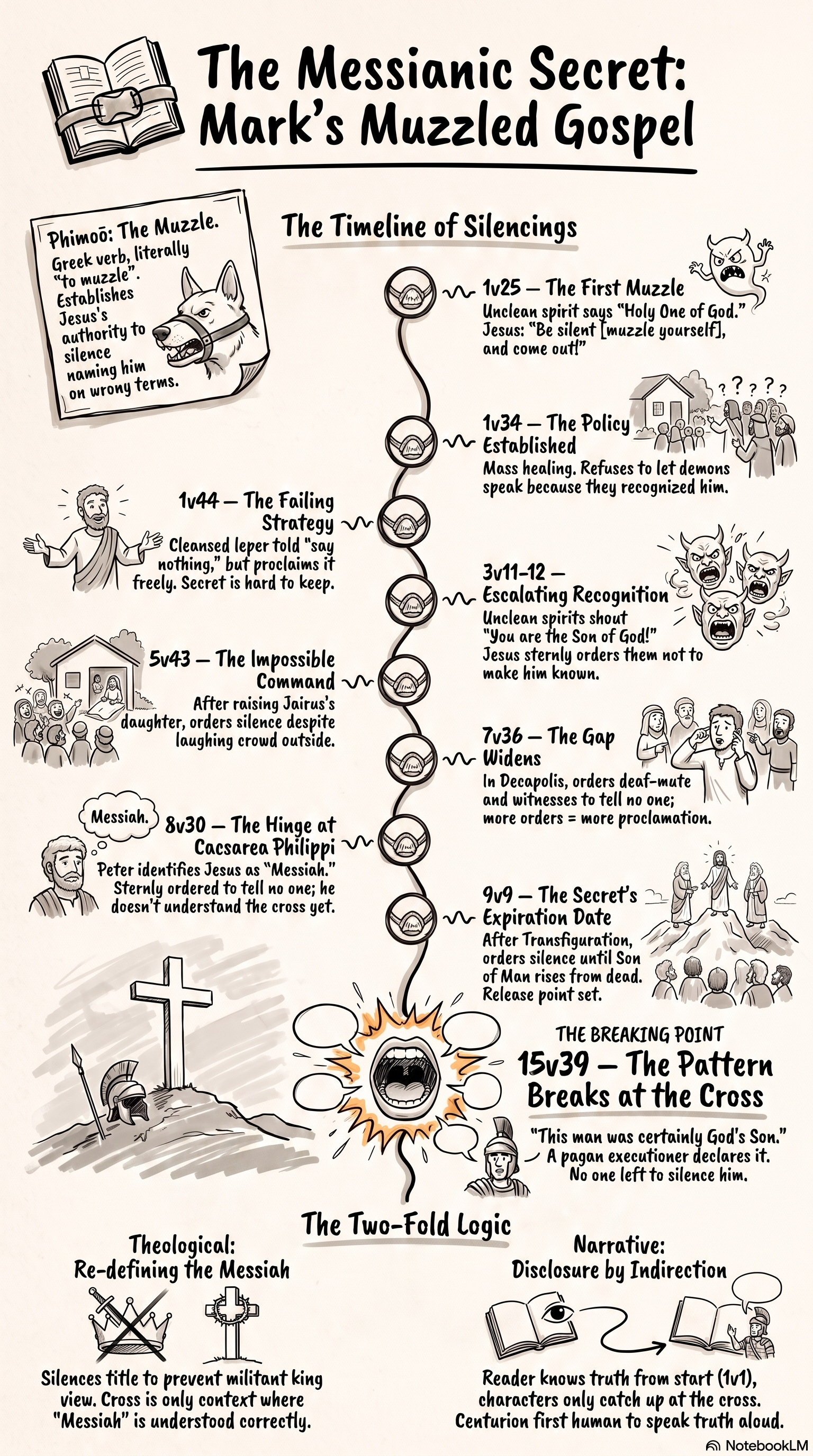
Two silencings sit inside this session's own material. At 8v30, immediately after Peter names Jesus as the Messiah, Jesus sternly ordered them not to tell anyone about him; the first passion prediction follows in the next verse. Peter has the right word (Messiah) with the wrong content, and cannot release the word until he has seen the cross.
At 9v9, coming down from the mountain after the voice from the cloud, Jesus ordered them to tell no one what they had seen, until after the Son of Man had risen from the dead. For the first time the silencing comes with an end date; the secret has a horizon, and the horizon is the resurrection. Mark builds this pattern across nine episodes from 1v25 to 9v9, and it breaks once, at 15v39, in the mouth of the Roman centurion at the foot of the cross.
See the reading tools collection for the wider set.
Exegetical key video
Practice for the week
Three to choose from, or write your own. Notice where in your own discipleship you have partial sight — where you see Jesus rightly but with the wrong content — and ask, gently, for the second touch. Or: sit with Jesus' question who do you say that I am? and answer it honestly in writing this week; notice what your answer assumes about what the answer costs. Or: practise listening this week — to one person, one teaching, one bit of scripture you have been avoiding — and notice what becomes available when you stop interrupting and let the voice be heard.
Materials for this session
Facilitator brief, participant workbook, and slide deck are available to registered leaders. Contact adrianroux@outlook.com for access.