On the Way · Session 12
Servant and seer
Mark 10v32–52
The hinge of Mark's Gospel. One question, asked twice, in the same chapter. Two answers that could not be further apart.
Pre-session video
By Mark 10v32 the road is running out. The long journey-section that began at Caesarea Philippi has carried Jesus and his disciples through three predictions of suffering, three failures to grasp what those predictions mean, and three teachings on what discipleship actually is. Jericho is fifteen miles short of Jerusalem; the entry is now in view. This passage gives us three units in sequence — a passion prediction, James and John asking for the seats of glory, and a blind beggar at the side of the road in Jericho — and they are not a sequence; they are an argument.
The argument turns on a single question Jesus asks twice in the same chapter, word for word in the Greek. What do you want me to do for you? Once to James and John in 10v36; once to Bartimaeus in 10v51. The Twelve ask for thrones. The beggar asks for sight. Mark is showing us what discipleship is not, and then, in the same chapter, what discipleship is.
The blind beggar is named twice — son of Timaeus, Bartimaeus — which is unusual in a Gospel that almost never names anyone Jesus heals. In this culture son of is not a way of naming whose father a man is; it is a way of naming whose way he follows. Son of Timaeus places the man in the philosophical world of Plato's Timaeus — a dialogue every educated Greek reader of Mark's day would have known, much-discussed for its argument about sight and seeing, and concerned with a perfect society (Atlantis) permanently lost beneath the waves. Bartimaeus calls out to the son of David — the messianic title of the one who is bringing in God's kingdom not as a lost ideal but as a present reality drawing near. He throws off his cloak, asks for sight, receives it, and follows on the way. The healing is, in Mark, the rejection of one path for another.
This session takes the political and the theological reading together. Bartimaeus is, on one level, a poor blind man whom the system has put at the side of the road, who refuses the silencing, who asks for what he needs, and who follows. He is also, on a second level, the figure of one whose way of seeing the world has been inadequate and who has turned. Both readings stand. Both are needed.
Exegetical key video
Reading tool: framing pericopes
Session 12 is where Mark's framing-pericope move becomes visible. The healing of the blind man at Bethsaida (8v22–26) and the healing of Bartimaeus at Jericho (10v46–52) sit at either end of the journey-section; the first is two-stage and partial, the second is one-stage and immediate. Between them run three passion predictions and three disciple failures. The disciples in the middle are still the man at Bethsaida, seeing partially; Bartimaeus is what full sight looks like, and full sight looks like following Jesus on the way.
Mark uses this wide-arc move more than once. The whole gospel is bracketed by two tearings using the same Greek verb schizō — the heavens torn at the baptism (1v10) and the sanctuary curtain torn at the cross (15v38). The work begins in Galilee (1v14) and returns to Galilee (16v7). The infographic below sets the three arches out in one image.
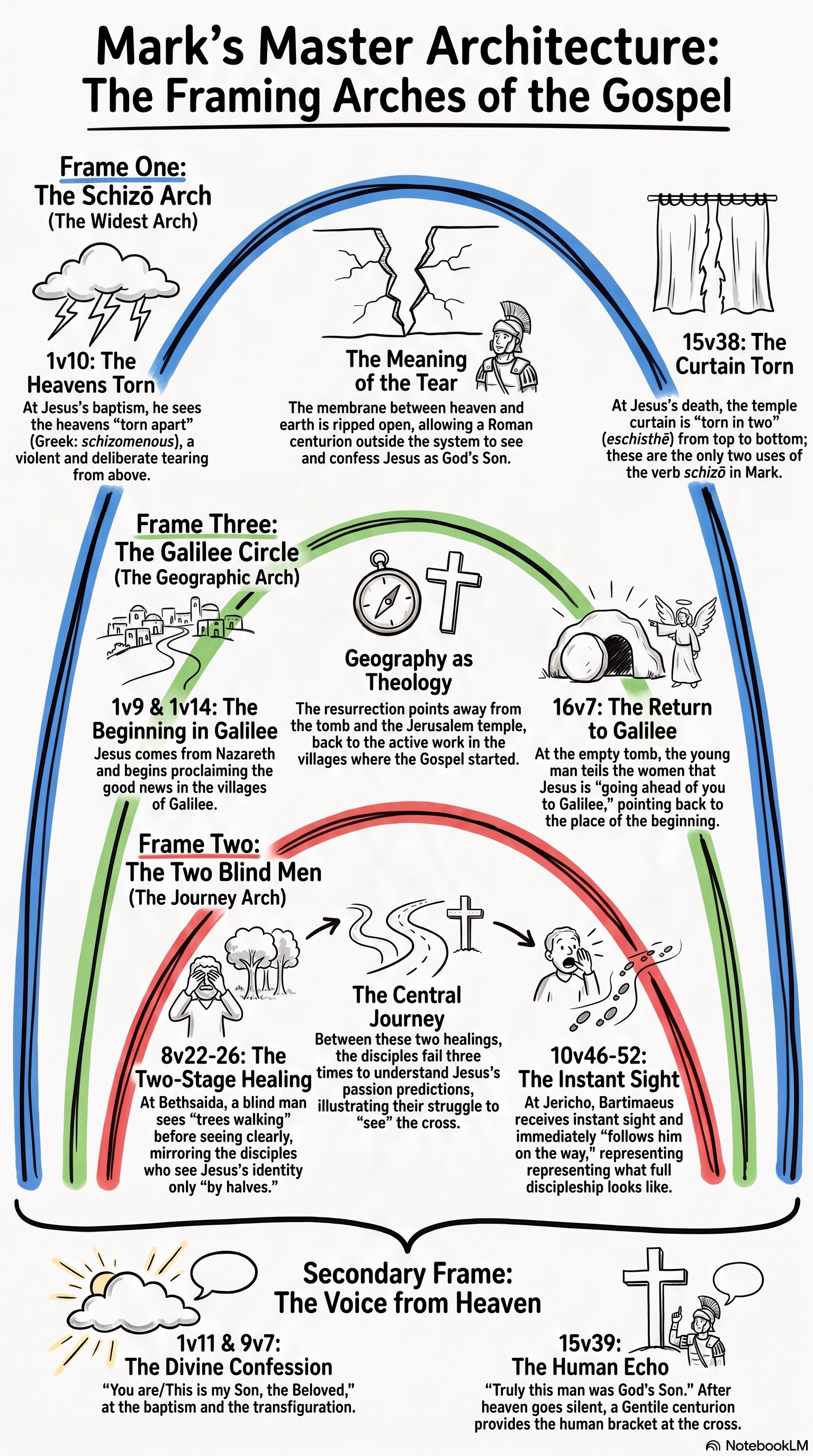
A fuller treatment of this and the other structural moves the course teaches is on the reading tools page.
Practice for the week
Three to choose from. When you hear someone shouting from the side of the road, do not be among those who tell them to be quiet; if you can stop, stop, and ask the question Jesus asks. Or: throw off something this week that defines you in a way that is in your way; notice what happens. Or: where you have been silenced, or have been silencing yourself, call out anyway; ask for what you need; refuse the polite suggestion that you keep quiet.
Materials for this session
Facilitator brief, participant workbook, and slide deck are available to registered leaders. Contact adrianroux@outlook.com for access. Pre-session participants are asked to read Mark 10v32–52 in their own Bibles during the week; the recommended translation is the New Revised Standard Version, Anglicised edition (NRSVA).