On the Way · Session 4
Alternative Israel
Mark 3v7–35
A crowd from every direction; twelve called; a charge of devilry; a family redefined. Mark is showing us what Jesus is making.
Pre-session video
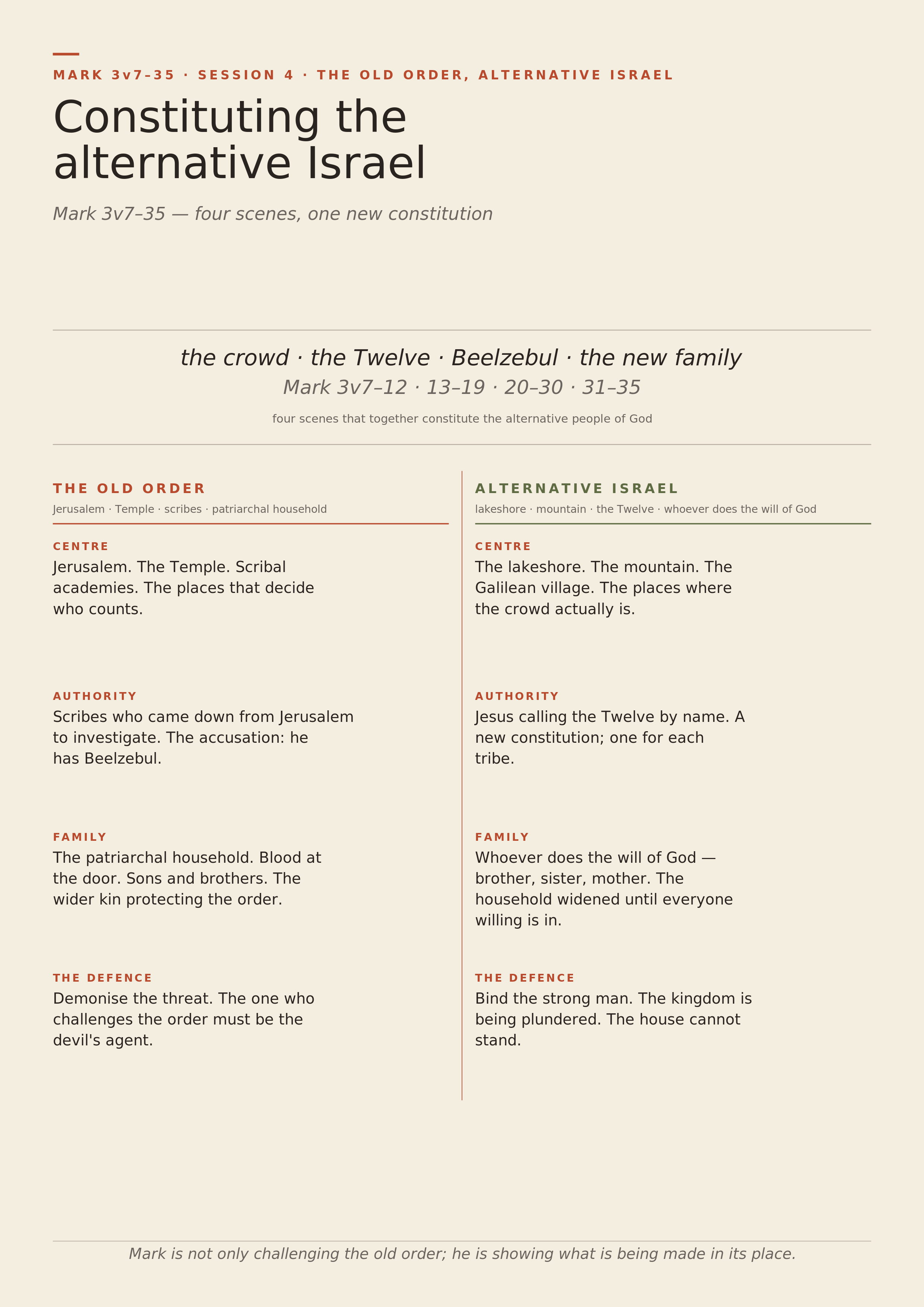
The first three sessions traced Jesus moving onto scribal turf in the synagogue, breaking the priestly purity code at the leper, releasing the paralytic from the debt code, eating with tax collectors, breaking the fast, breaking the sabbath. The first conspiracy to kill him is in place. Now Mark stops and shows us what Jesus is making in the wreckage of the old order.
The list of places the crowd comes from at 3v7–8 is not throwaway. The names trace, almost exactly, the territorial extent of the old kingdom of David and Solomon, plus a little extension into Phoenicia and Idumea. Mark is showing the wider Israel — and its margins — gathering at the lakeside. And then Jesus goes up the mountain, like Moses, and calls twelve. The number is deliberate; twelve tribes; one for each. The point is the symbol. This is the reconstitution of Israel.
Three things to watch for
The first is the geography. Mark sets the wide-Israel crowd against the Jerusalem authorities; the lakeshore against the temple; the mountain-call against the scribal centre. The political map of the gospel is being drawn.
The second is the Beelzebul controversy (3v22–30). The scribes have come down from Jerusalem and accused Jesus of casting out demons by the prince of demons. Jesus answers with the strong-man parable. The political war of myths has begun; this is the establishment striking back; the answer is that the kingdom Jesus is bringing is the binding of the strong man, not his ally.
The third is the redefinition of family (3v31–35). Whoever does the will of God is my brother and sister and mother. Jesus does not exclude his blood family; he widens family until it includes anyone willing to share the work. The patriarchal household, the central institution of first-century Mediterranean society, has been quietly subverted.
Exegetical key video
Practice for the week
Three to choose from, or write your own. Find one person this week who is not in your usual circle of welcome; invite them in. Or: notice one place this week where language is being used to demonise a person or group whose challenge to the established order makes them inconvenient; notice it and refuse the language. Or: ask what your immediate family looks like if family is defined by shared work in the kingdom rather than by blood; consider who is in that family and who is being kept out.
Materials for this session
Facilitator brief, participant workbook, and slide deck are available to registered leaders. Contact adrianroux@outlook.com for access.